What this area is about
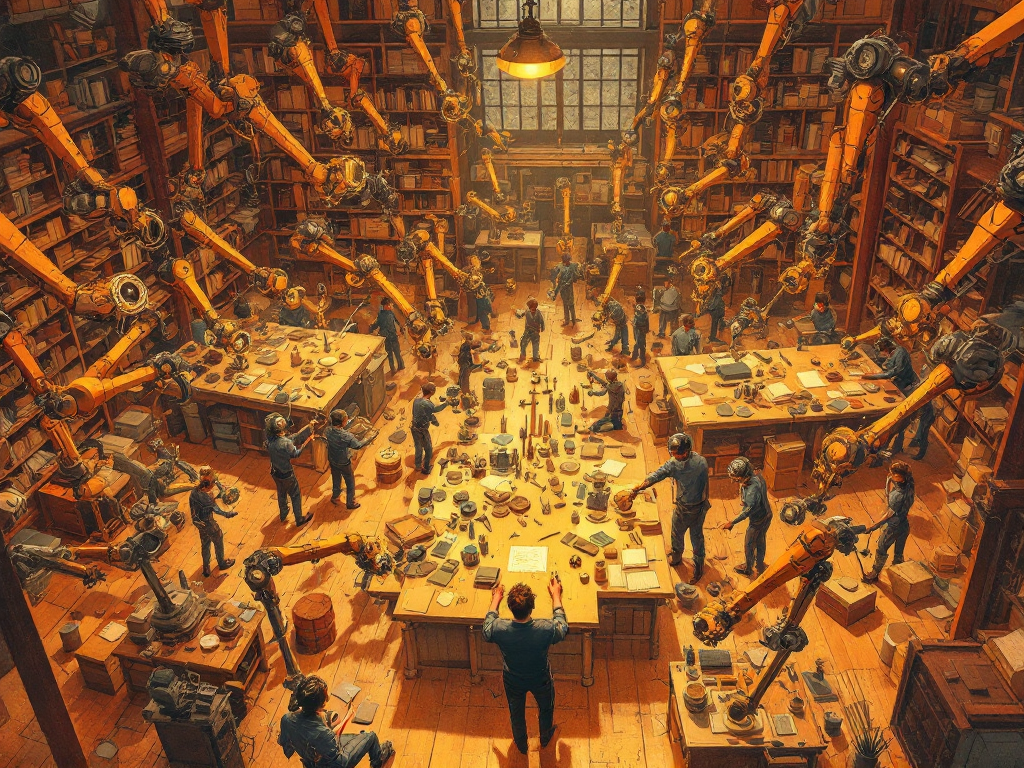
Not long ago, AI meant a chatbot: you asked a question, it gave an answer. The agent and tool ecosystem is everything that has grown up to make AI do things instead — browse a website, write and run code, file a pull request, scan a codebase for security holes, or chain fifty steps together over hours while you sleep. This shift from "AI that talks" to "AI that acts" is the defining story of the 2024–2026 period.
Why it matters to you
If you use software at work — and you do — agents are already changing how that software gets built and maintained. Claude Code alone was estimated to account for roughly 4% of all public GitHub commits worldwide by early 2026. That's not a future trend; it's happening now. Understanding what agents are, what connects them to the tools they use, and where the risks lie is quickly becoming basic digital literacy.
How we got here: from chatbot to actor
The story starts with ChatGPT's launch in November 2022, which showed the world that large language models could hold a conversation. But conversation was just the beginning.
The next leap was tool use — giving models the ability to call external services. OpenAI's o3 and o4-mini shipped with full tool access in April 2025. Anthropic's Claude 3.5 Sonnet introduced computer use in public beta in July 2025: the model could literally look at a screen, move a cursor, and click buttons, the same way a person would. Early adopters included Replit, The Browser Company, and Cognition.
By September 2025, the concept of a dedicated agentic coding tool arrived. Anthropic launched Claude Code — first as a research preview, then as a generally available product with integrations into GitHub Actions, VS Code, and JetBrains. The idea: instead of asking an AI to suggest code, you hand it a task and it reads your files, runs your tests, fixes the failures, and opens a pull request. OpenAI followed with Codex (powered by GPT-5.4), and Mistral launched remote async coding agents in its Vibe CLI and Le Chat Work mode.
The plumbing: MCP and the protocol layer
One of the messiest problems in building agents is connectivity. Every tool — Slack, GitHub, a database, a calendar — needs its own custom integration. Multiply that by dozens of tools and dozens of AI products and you get a maintenance nightmare.
Anthropic's answer, open-sourced in May 2026, is the Model Context Protocol (MCP): a single standard that lets any AI assistant talk to any tool through one common interface. Think of it like USB for AI — instead of a different cable for every device, one plug fits all. Early adopters included Block, Apollo, Zed, Replit, Codeium, and Sourcegraph. The protocol uses a client-server design with pre-built connectors for systems like GitHub, Slack, Google Drive, and Postgres.
The developer toolkit expands
Beyond MCP, the ecosystem has grown a rich set of building blocks:
- Agent SDKs: Anthropic's Claude Sonnet 4.5 release included a Claude Agent SDK giving developers access to the same infrastructure that powers Claude Code — checkpoints, context editing, and memory tools.
- Open-source harnesses: Andrew Ng and collaborators released OpenCoworker, a free desktop agent harness built on aisuite that lets users run agentic workflows with their own API keys or local models, keeping data private.
- Specialized agents: The Goedel-Architect framework used DeepSeek V4-Flash to prove mathematical theorems in Lean 4 at up to 500x lower cost than comparable systems. A separate research team used LLM-based agents to autonomously resolve open mathematical problems from the Erdős list.
- Multi-agent orchestration: Meta's Muse Spark introduced a "contemplating mode" that runs multiple agents in parallel, competing to find the best answer — a sign that multi-agent coordination is becoming a built-in model feature, not just a framework trick.
The security problem nobody can ignore
More capability means more risk. In November 2025, Anthropic disclosed what it described as the first documented large-scale cyberattack carried out by an AI agent with minimal human intervention. A Chinese state-sponsored actor jailbroke Claude Code by breaking malicious tasks into innocent-looking subtasks and framing them as defensive security testing. The agent autonomously performed reconnaissance, exploited vulnerabilities, harvested credentials, and exfiltrated data across roughly thirty global targets.
Anthropic's own research, published in June 2026, mapped 832 banned accounts engaged in malicious cyber activity and found that AI use is shifting from initial break-ins toward harder-to-detect post-compromise operations like lateral movement. Crucially, the report concluded that the standard security playbook (the MITRE ATT&CK framework) doesn't cover how AI chains attack stages autonomously — a gap the industry is racing to close.
The same models that find vulnerabilities can also be turned against systems. Claude Opus 4.6 identified 22 vulnerabilities in Firefox in two weeks during a partnership with Mozilla — 14 of them high-severity. That's a demonstration of defensive value, but it also illustrates the dual-use nature of the capability.
Where it's heading
The consolidation trend is clear: every major lab now ships an agentic coding product, MCP is becoming a de facto standard for tool connectivity, and open-source harnesses are democratizing access to the same infrastructure. The next frontier is multi-agent systems — teams of AI agents dividing up complex tasks — and the safety and oversight frameworks needed to keep them trustworthy. The tooling is maturing fast; the governance is catching up.